0. Overview
EN 1822 is the European standard for high-efficiency particulate air filters – commonly known as EPA, HEPA and ULPA filters. It defines the world's most widely recognised filter classes: E10, E11, E12, H13, H14, U15, U16 and U17, covering overall efficiencies from 85 % to 99.999995 %. Classification is based on the MPPS (Most Penetrating Particle Size) – the particle diameter at which the filter medium exhibits its lowest collection efficiency. Since 2019, EN 1822 references the international standard ISO 29463 for all test methods (Parts 2–5), while retaining its own classification system that is firmly established across the industry.
Current editions:
| Standard / Part | Scope | Current edition |
|---|---|---|
| EN 1822-1 | Classification, performance testing, marking (E10–U17) | 2019 |
| ISO 29463-2 | Aerosol generation, measuring equipment, particle counting statistics | 2018 (replaces EN 1822-2) |
| ISO 29463-3 | Testing flat-sheet filter media | 2018 (replaces EN 1822-3) |
| ISO 29463-4 | Leak test – scan method | 2018 (replaces EN 1822-4) |
| ISO 29463-5 | Test method for filter elements (MPPS efficiency) | 2018 (replaces EN 1822-5) |
| ISO 29463-1 | International classification (13 classes ISO 15E–ISO 75U) | 2024 (3rd revision) |
1. History of EN 1822 – Europe's answer to MIL-STD-282
The development of high-efficiency particulate filters began in the late 1940s as part of the Manhattan Project and military gas-mask research. The first standardised test method – the American military standard MIL-STD-282 (1956) – employed a DOP aerosol test at a fixed particle size of 0.3 µm. This methodology was ground-breaking but physically simplistic: filter efficiency does not reach its minimum at a fixed particle size but at a media-specific diameter – the MPPS.
Europe recognised this limitation and published the first edition of EN 1822 in 1998. The standard introduced the world's first performance-based classification system grounded in the MPPS principle – a fundamental advance over the 0.3 µm fixation. At the same time, EN 1822 established the scan test as the reference method for leak testing: every individual HEPA and ULPA filter element is scanned non-destructively across its entire surface to detect even the smallest local leak sites.
The current edition EN 1822-1:2019 modernises the classification framework and references the ISO 29463 series (Parts 2–5) for all test procedures. The EN 1822 classes E10 through U17 remain unchanged – they are firmly embedded in procurement specifications, GMP guidelines, cleanroom standards and tender documents worldwide.
2. The MPPS principle – core concept of EN 1822
The concept of the Most Penetrating Particle Size (MPPS) is the key distinction between EN 1822 and older test methods. Air filters exploit several physical collection mechanisms simultaneously:
| Collection mechanism | Effective for | Efficiency for small particles |
|---|---|---|
| Inertial impaction | Large particles > approx. 1 µm | Low |
| Interception | Medium particles ~0.5–2 µm | Medium |
| Diffusion (Brownian motion) | Very small particles < approx. 0.3 µm | High (increases with decreasing size) |
| Electrostatic attraction | All sizes (media-dependent) | Variable, not permanently reliable |
The interplay of these mechanisms produces an efficiency minimum – the MPPS – typically in the range of 0.1 to 0.3 µm. An H13 filter achieving 99.95 % efficiency at its MPPS will perform better at all other particle sizes. EN 1822 determines the MPPS individually for each filter type and classifies based on the efficiency measured precisely at that point. The result is a physically honest worst-case value – not an optimistic figure obtained at an arbitrarily chosen test-particle size.
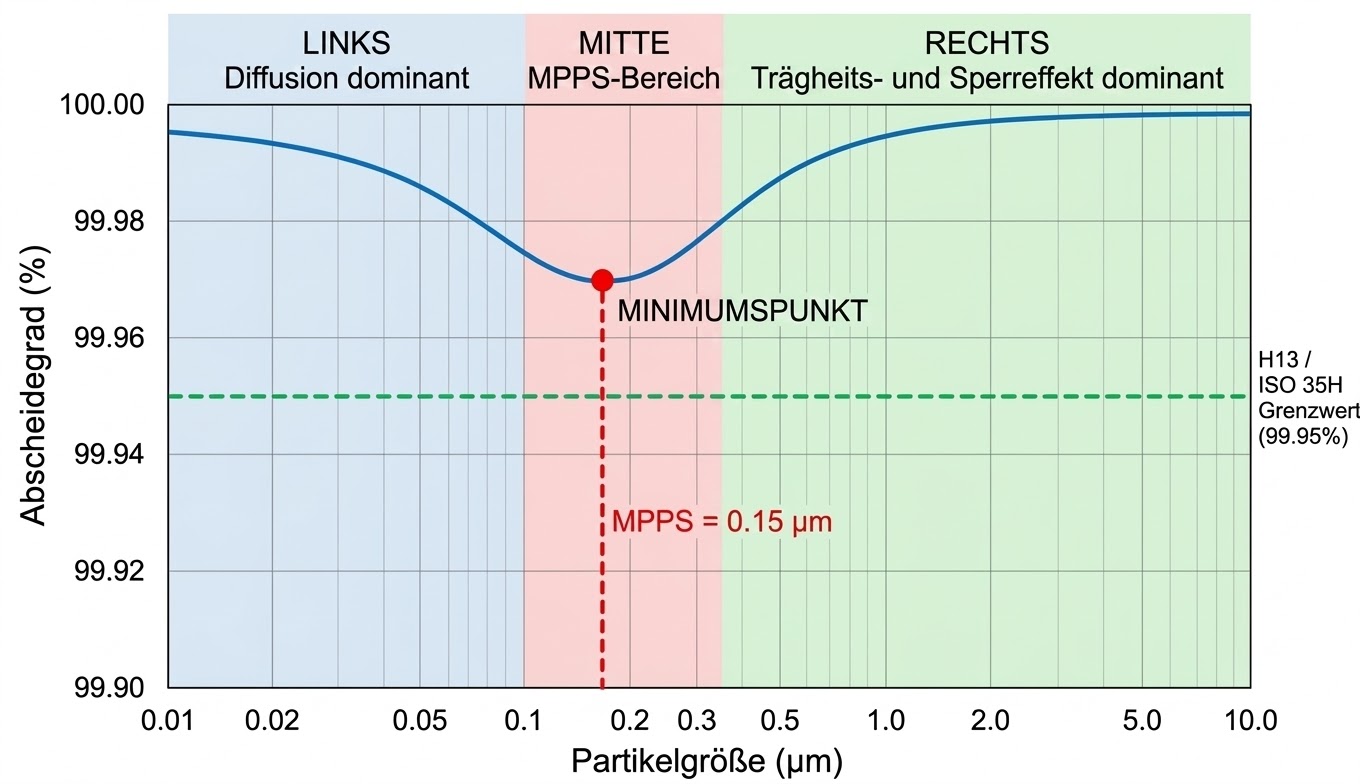
The MPPS efficiency curve of a HEPA filter according to EN 1822: collection efficiency reaches its minimum at approximately 0.15 µm – the Most Penetrating Particle Size. Below the MPPS, diffusion dominates; above it, impaction and interception take over. The dashed line marks the EN 1822 H13 threshold at 99.95 %. A filter passes class H13 only if its efficiency at the MPPS meets or exceeds this threshold.
3. EN 1822 filter classes in detail
EN 1822-1:2019 defines eight filter classes in three groups:
| EN 1822 class |
Group | Overall efficiency (integral at MPPS) |
Max. local penetration |
ISO 29463 equivalent |
|---|---|---|---|---|
| E10 | E (EPA) | ≥ 85 % | – | – (no ISO equivalent) |
| E11 | E (EPA) | ≥ 95 % | – | ISO 15 E |
| E12 | E (EPA) | ≥ 99.5 % | – | ISO 25 E |
| H13 | H (HEPA) | ≥ 99.95 % | ≤ 0.25 % | ISO 35 H |
| H14 | H (HEPA) | ≥ 99.995 % | ≤ 0.025 % | ISO 45 H |
| U15 | U (ULPA) | ≥ 99.9995 % | ≤ 0.0025 % | ISO 55 U |
| U16 | U (ULPA) | ≥ 99.99995 % | ≤ 0.00025 % | ISO 65 U |
| U17 | U (ULPA) | ≥ 99.999995 % | ≤ 0.0001 % | ISO 75 U |
Key notes on the class structure:
- E10 is exclusive to EN 1822 – the international standard ISO 29463 starts at 95 % (ISO 15E, equivalent to E11). For E10 requirements (85–95 %), EN 1822 is the only applicable high-efficiency filter standard.
- EPA filters (E10–E12) are classified by statistical sample testing; a scan test is not required.
- HEPA and ULPA filters (H13–U17) are individually tested – every single filter element receives its own test certificate documenting both overall efficiency and local penetration from the scan test.
- EN 1822-1:2019 sets stricter requirements than ISO 29463: it explicitly prohibits aerosol photometers for leak testing and mandates the scan test with a particle counter for all H and U class filters.
4. The scan test – heart of EN 1822 testing
The scan method is the reference test procedure of EN 1822 for HEPA and ULPA filters. A particle counter traverses the entire filter surface systematically – filter media, frame bonding and gasket seat – recording local penetration values on a defined grid resolution.
The scan test reliably detects:
- Broken or damaged microglass fibres in the media
- Pinholes and defects in the filter pack
- Faulty bonding between media and frame
- Leaks at the gasket seat
A filter passes the leak test only if no single measurement point across its entire surface exceeds the maximum permissible local penetration for its class. For an H13 filter, this means: local penetration must not exceed 0.25 % at any point. This requirement is far more stringent than a purely integral test – a filter may achieve excellent overall efficiency yet still fail due to a single localised defect.
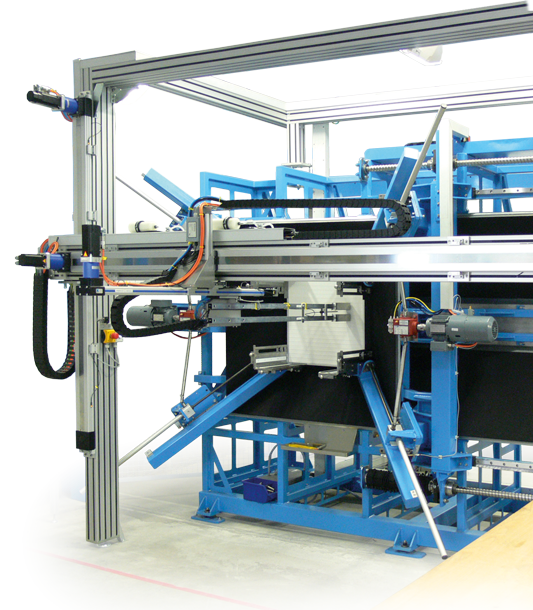
The EN 1822 scan test rig at HS-Luftfilterbau GmbH in Kiel, Germany: every HEPA and ULPA filter is individually and non-destructively tested for overall efficiency and local leak sites – from standard 610×610 mm elements to custom sizes for cleanrooms, offshore platforms and nuclear facilities.
5. EN 1822 and ISO 29463 – coexistence of two standards
EN 1822 and ISO 29463 are not competing standards but two layers of the same system:
- EN 1822-1:2019 defines filter classes E10 through U17 and is the governing standard for classification and marking in Europe. These class designations – particularly H13 and H14 – are embedded in GMP guidelines, procurement specifications and cleanroom standards worldwide.
- ISO 29463 (Parts 2–5) provides the test methods to which EN 1822-1:2019 refers in full. In practice, this means: EN 1822 classification + ISO 29463 test methodology.
- ISO 29463-1:2024 additionally defines an independent international classification system with 13 grades (ISO 15E to ISO 75U). This is primarily used in regions where EN 1822 classes are less common – such as the USA, Japan and South-East Asia.
Key differences between EN 1822 and ISO 29463:
| Criterion | EN 1822-1:2019 | ISO 29463-1:2024 |
|---|---|---|
| Scope | Europe (CEN) | International (ISO) |
| Filter classes | 8 classes: E10–U17 | 13 classes: ISO 15E–ISO 75U |
| Lower boundary | 85 % (E10) | 95 % (ISO 15E) – no E10 equivalent |
| Upper boundary | 99.999995 % (U17) | 99.999995 % (ISO 75U) |
| Scan test requirement | Stricter – particle counter only, photometers explicitly prohibited | Photometers still permitted for certain classes |
| Test methods (Parts 2–5) | References ISO 29463 | Defined independently |
| Use in specifications | Dominant – H13/H14 referenced globally | Growing in Asia-Pacific |
An H14 filter per EN 1822 (overall efficiency ≥ 99.995 % at MPPS) corresponds to class ISO 45 H in the ISO 29463 system. The mapping is not always one-to-one, however – ISO 29463 includes intermediate classes such as ISO 20E, ISO 25E and ISO 30E that have no direct EN 1822 counterpart.
6. Test certificates – why every EN 1822 filter is unique
A defining feature of EN 1822: HEPA and ULPA filters are not tested by statistical sampling but individually and non-destructively. Every filter element of class H13 and above receives an individual test certificate documenting:
- Overall efficiency at MPPS (integral collection efficiency)
- Local penetration from the scan test (maximum single value across the entire filter face)
- Pressure drop at rated airflow
- Serial number and unique batch traceability
This test certificate is not merely a quality record – it is a regulatory document. In pharmaceutical facilities operating under EU GMP Annex 1, in nuclear plants governed by KTA 3601 and in cleanrooms compliant with ISO 14644, the factory certificate serves as the reference for in-situ testing on site. Filters without a complete EN 1822 individual test certificate may not be installed in these regulated environments.
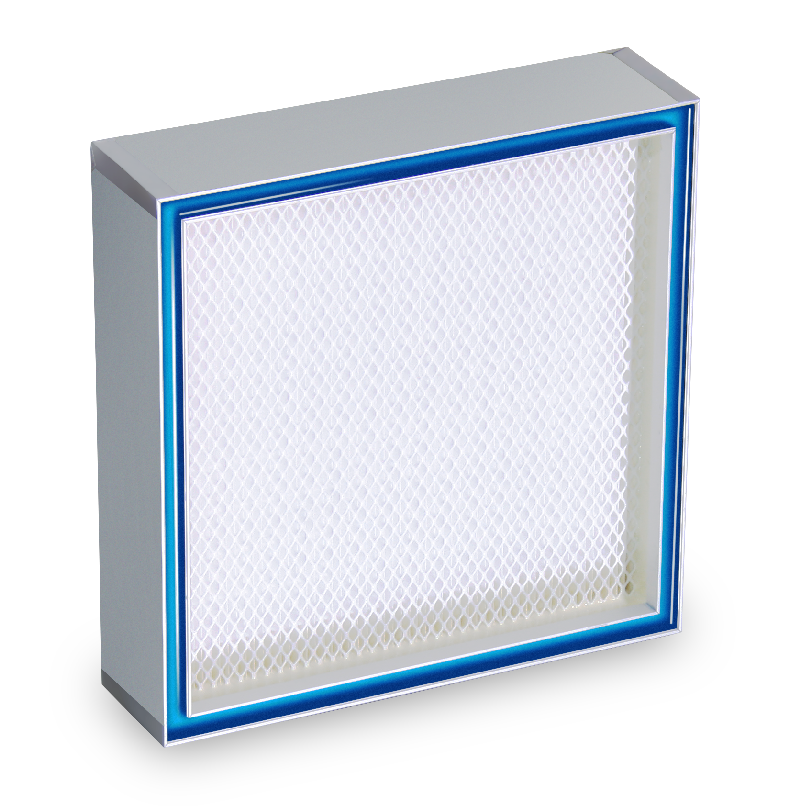
Pictured: HS-Mikro SF-AL HEPA filter with gel seal – individually tested to EN 1822, certified for pharmaceutical cleanrooms, GMP facilities and isolators. Details at www.luftfilterbau.de.
7. Applications: where EN 1822 filters are required
| Application | Typical EN 1822 class | Governing standard |
|---|---|---|
| Pharmaceutical sterile manufacturing, filling lines | H14 | EU GMP Annex 1 (2022), ISO 14644-1 |
| Cleanrooms ISO Class 1–5 (semiconductors, optics) | U15–U17 | ISO 14644-1/-3, SEMI standards |
| Cleanrooms ISO Class 5–8 (general) | H13–H14 | ISO 14644-1, VDI 2083 |
| Operating theatres, intensive care units | H13–H14 | DIN 1946-4, HTM 03-01 (UK) |
| Nuclear air filtration | H13–H14 (special requirements) | KTA 3601, IAEA standards |
| Biosafety laboratories BSL-3 / BSL-4 | H14 | WHO Laboratory Biosafety Manual, EN 12469 |
| Offshore wind / gas turbine intake air | E11–H14 (depending on stage) | EN 1822, ISO 29461 |
| Food and beverage production | H13–H14 | IFS, BRC, HACCP guidelines |
HS-Luftfilterbau GmbH manufactures and tests HEPA and ULPA filters to EN 1822 for all of the above applications – from standard elements for cleanroom ceilings to bespoke designs for offshore platforms, pharmaceutical isolators and nuclear facilities. More at www.luftfilterbau.de.
8. EN 1822 in multi-stage filter systems
In practice, HEPA filters to EN 1822 form the final stage of multi-stage HVAC and air handling systems. The pre-filter stages are classified to ISO 16890 – from ISO Coarse (coarse dust) through ISO ePM10 and ISO ePM2.5 to ISO ePM1 (fine particulate). The boundary between the two standards:
- ISO 16890 extends up to ISO ePM1 >95 %, which roughly corresponds to EN 1822 class E10.
- EN 1822 starts at E10 (≥ 85 % at MPPS) and extends to U17 (≥ 99.999995 %).
- For molecular gas-phase contaminants (VOCs, ozone, odours), ISO 10121 complements the particle filter standards.
Correct pre-filter sizing is critical for the service life and cost-effectiveness of the HEPA final stage. HS-Luftfilterbau GmbH designs and supplies all filter stages from a single source – from ISO ePM1 bag filters to U17 ULPA filters – and provides expert advice on optimal staging.
9. Related standards and regulations
| Standard | Relationship to EN 1822 |
|---|---|
| ISO 29463 | International counterpart; test methods (Parts 2–5) are identical, classification more finely graded (13 classes) |
| ISO 16890 | Pre-filters and general ventilation – the stage below HEPA |
| ISO 10121 | Molecular gas-phase filters (adsorption, chemisorption) – complements EN 1822 with the gas-filtration component |
| ISO 29461 | Gas turbine intake air filters – frequently uses EN 1822-classified HEPA elements in the final stage |
| ISO 14644-1/-3 | Cleanroom classification ISO 1–9; Part 3 defines in-situ filter testing in the installed state |
| EU GMP Annex 1 (2022) | Sterile pharmaceutical manufacturing; H13/H14 filters explicitly required |
| KTA 3601 | German nuclear safety rule for ventilation systems in nuclear power plants |
| DIN 1946-4 | Hospital ventilation systems; requirements for operating theatres and intensive care |
| VDI 2083 | Cleanroom technology; comprehensive guideline for design, construction and operation |
| MIL-STD-282 (USA) | Historical US test standard; predecessor of the MPPS concept, still normative in many US applications |
| EN 12469 | Microbiological safety cabinets; H14 filters required for Class II and Class III cabinets |
HEPA & ULPA filters to EN 1822
HS-Luftfilterbau GmbH manufactures EPA, HEPA and ULPA filters to EN 1822 in classes E10 through U17. Every filter is individually tested on our in-house EN 1822 scan test rig. Pictured: HS-Mikro SF-AL with gel seal for pharmaceutical cleanrooms.
- HEPA & ULPA filters – HS-Luftfilterbau
- Cleanroom & pharma applications
- HEPA filters in our online shop
- ISO 29463 – International HEPA/ULPA standard
- ISO 16890 – Pre-filters & general ventilation
- ISO 10121 – Molecular gas-phase filters
- ISO 29461 – Gas turbine intake filters
- Fundamentals of air filtration
- EN 1822 at DIN Media
- Request test certificates & consultation
Further information
EN 1822 scan test rig
Every HEPA and ULPA filter is individually tested on our in-house EN 1822 scan test rig – for overall efficiency, local leak sites and pressure drop. The individual test certificate accompanies the filter throughout its entire service life.
HS-Luftfilterbau GmbH
Leading manufacturer of air filters for HVAC, ventilation and cleanroom technology based in Kiel, Germany. In-house EN 1822 / ISO 29463 test laboratory. Certified to ISO 9001, ISO 14001 and KTA 3601.
- HEPA/ULPA E10–U17 to EN 1822
- ISO 29463 classes ISO 15E to ISO 75U
- Bag filters to ISO ePM1 85 %
- Compact filters to ISO ePM1 95 %
- Custom filters for offshore, pharma & nuclear